2025 California Firefighter Total Compensation Survey
Executive Summary
The California Department of Human Resources (CalHR) is required by Government Code section 19827.3 to “take into consideration the salary and benefits of other jurisdictions employing 75 or more full-time firefighters who work in California.”
To complete this requirement, CalHR selected four state firefighter classifications as benchmarks in this report. CalHR and the union representing state firefighters, CAL FIRE Local 2881, mutually agreed upon a sample of 20 local fire departments to include in this survey.
The data collected allowed CalHR to compare the monthly total compensation, expressed as monthly employer costs for salaries, cash benefits, health and retirement benefits, Extended Duty Week Compensation (sometimes called EDWC or planned overtime), and the value of accrued leave, for state and local firefighters.
When comparing total compensation with 20 fire departments across California, the state lagged behind each benchmark classification.
The state’s monthly total compensation lag for each benchmark classification has increased since 2023. The simple average lag has increased from 16.7% in 2023 to 26.9% in 2025.
Survey Background
The California Department of Forestry and Fire Protection, known as Cal Fire, is responsible for protecting the state’s wildlands, and also provides urban fire protection for thousands of California residents where it is contracted by local government agencies. Cal Fire’s jurisdiction extends the length and breadth of the state, and the heart of its emergency response and resource protection capability is its full-time fire professionals, foresters, administrative employees, and seasonal firefighters. Cal Fire also coordinates the work of thousands of local firefighters.[1]
To ensure the recruitment and retention of qualified firefighters, Government Code section 19827.3 requires CalHR to “consider prevailing salaries and benefits” of local fire departments in California employing 75 or more full-time firefighters. This total compensation report comparing the monthly total compensation for state firefighter classifications with 20 local fire departments allows CalHR to fulfill this requirement.
Survey Methodology
Cal Fire Local 2881 identified 68 fire departments in California with 75 firefighters or more, which CalHR verified. At CalHR’s recommendation, the five fire departments with the highest base salaries, and the five fire departments with the lowest base salaries, were removed from the list. Then 20 departments were randomly selected to be surveyed. The names of the local fire departments selected appear below:
- Bakersfield City
- Chula Vista City
- Corona City
- Escondido City
- Fullerton City
- Hayward City
- Huntington Beach
- Livermore-Pleasanton FD
- Los Angeles County
- Milpitas City
- Novato Fire District
- Ontario City
- Oxnard City
- Rialto City
- Roseville City
- San Mateo Consolidated FD
- Santa Monica City
- Stockton City
- Torrance City
- Ventura County
Four benchmark classifications were agreed upon to represent a cross-section of firefighting classifications at Cal Fire for this report:
- Firefighter II
- Fire Apparatus Engineer
- Fire Captain, Range A
- Fire Battalion Chief
CalHR developed a survey instrument with detailed questions for this report. Many questions in the survey instrument focused on monthly salary, Extended Duty Week Compensation (EDWC or otherwise known as planned overtime), cash benefits, and employee benefits (such as retirement contribution practices, health, dental and vision insurance contributions, hours worked, and leave practices).[2] Information for each classification was requested separately.
CalHR prefilled the survey instruments by data mining information found on public websites. Once the data mining was complete, CalHR contacted each jurisdiction to verify the information collected to be used in the total compensation calculations.[3]
Survey Findings
Comparing Monthly Base Pay Only
When comparing maximum base pay, the salaries of the state benchmark classifications lagged behind the surveyed fire departments by an average of 76.7%.
Table 3, below, shows a dollar value and a corresponding percentage lag for the four benchmark classifications.
Comparing Total Compensation
As used in this report, total compensation is defined as the employer’s cost for salaries and benefits. The maximum salary of each benchmark classification is combined with the following benefits to calculate total compensation:
- EDWC
- Education Pay
- EMT/Paramedic Pay
- Hazmat Pay
- Longevity Pay
- Uniform Allowance
- Bilingual Pay
- Employer contributions to pension and/or deferred compensation plans
- Employer contributions to health, dental, and vision plans
- Value of accrued leave
Table 4, below, compares total compensation for state firefighters and local firefighters.
Summary of Monthly Total Compensation
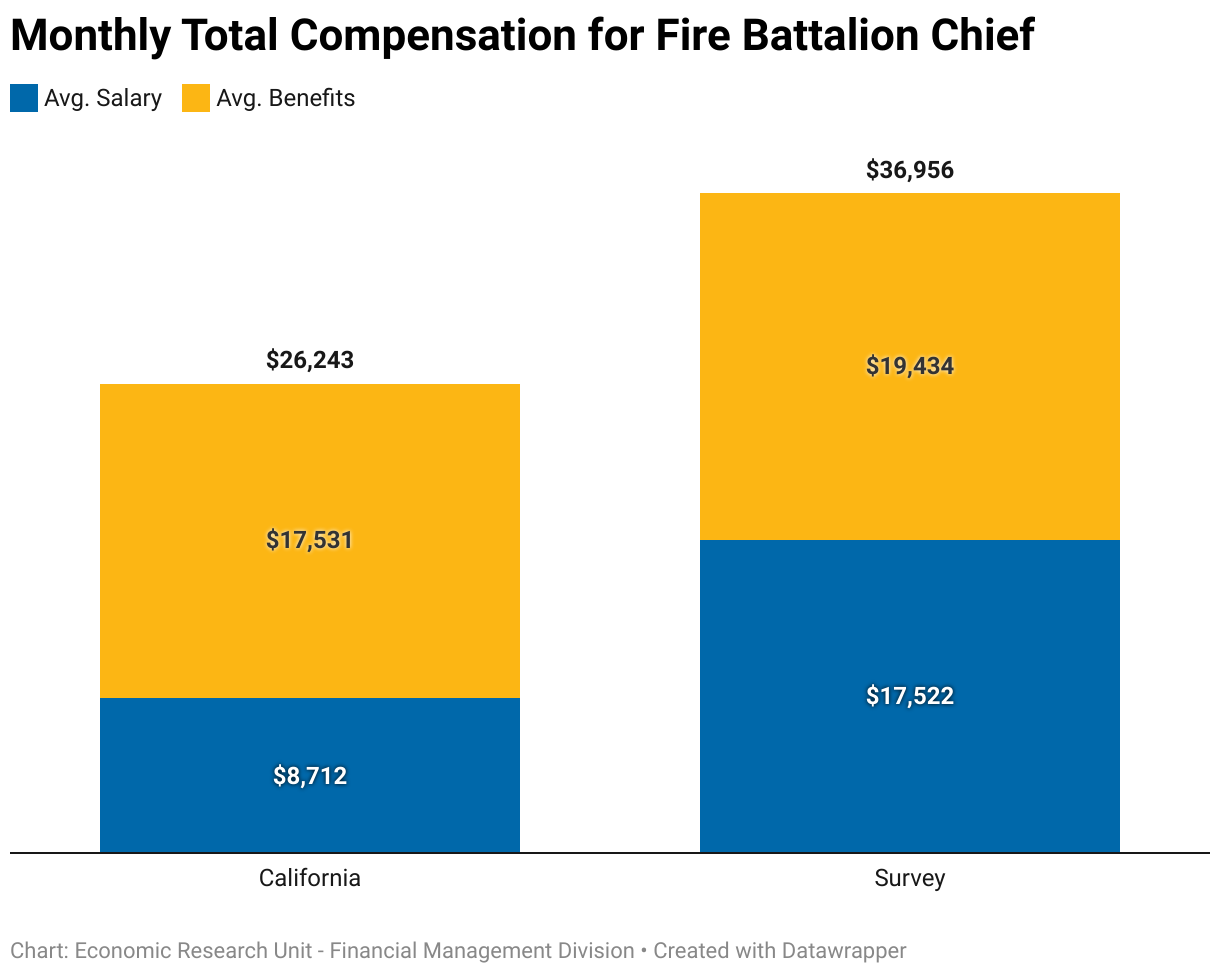
The charts below compare the value of pay and benefits for the state and the survey average for each classification. They compare the monthly costs of compensation for employers, but do not include the employer’s costs for unplanned overtime for state or local firefighters, nor include the costs for providing retiree health.[4]
Extended Duty Week Compensation (EDWC)
The federal Fair Labor Standards Act (FLSA) allows employers to set “work periods” for firefighters that exceed the traditional 40-hour workweek. The work period must be at least seven consecutive workdays; it may extend up to a maximum of 28 consecutive workdays. Table 5, below, shows the maximum duty hours for each work period after which the employee is entitled to FLSA overtime pay. The same federal regulations also cover local firefighters.
Both state and local firefighters work 24-hour shifts, but state firefighters are scheduled to work more days of the year (143 days compared to 121 days for the local fire departments in the survey). Consequently, state firefighters are working more hours of planned overtime because they are working more days than their peers in local government.
On average, state firefighters are currently scheduled to work 56.3 hours of EDWC every month. Out of the 20 local fire departments surveyed for this report, 19 have scheduled EDWC hours which are not included in their base pay.
Table 6 compares EDWC pay. This report does not include a comparison of pay for unplanned overtime between state and local firefighters.
Employer Contributions to Retirement and Health
For the purposes of this report, we compared employer contributions to retirement for “classic” employees – firefighters hired prior to January 1, 2013, and typically enrolled in the 3% at 50 retirement plan. The following components are included in the firefighter’s retirement benefits: the net employer contribution towards retirement and the employer’s maximum contribution to a deferred compensation retirement savings plan.[5] To find the value of employer contributions to health benefits, we combined the employer contributions to a cafeteria plan (a plan that permits employees to receive certain benefits), as well as health, dental, and vision premiums.[6]
Table 7 compares the employer contributions to retirement as well as health benefits for the state and local fire departments.
Although employer retirement contribution rates do not always affect the take-home pay or the ultimate retirement benefit for the employee, they typically reflect a substantial portion of the employer’s cost for employee benefits.
CalPERS Retirement Plans
Of the 20 local fire departments included in this survey, 17 participated in a California Public Employees’ Retirement System (CalPERS) retirement plan. This group includes the Livermore-Pleasanton Fire Department, the San Mateo Consolidated Fire Department, and the cities of Bakersfield, Chula Vista, Corona, Escondido, Fullerton, Hayward, Huntington Beach, Milpitas, Ontario, Oxnard, Rialto, Roseville, Santa Monica, Stockton, and Torrance.
1937 County Employee Retirement Plans
The three remaining fire departments in the survey participate in a local retirement system allowed under provisions of the County Employees Retirement Law of 1937. Under this law, California counties may establish their own retirement systems, which are independently managed and operated separately from CalPERS. The three fire departments in this survey that participate in such a plan are:
- Los Angeles County (Los Angeles County Employees Retirement Association)
- Novato Fire District (Marin County Employees Retirement Association)
- Ventura County (Ventura County Employees Retirement Association).
On average, the 20 local jurisdictions contributed a net between 50.88% and 52.4% of the employees’ monthly compensation to retirement. By contrast, the state’s contribution rate used in this report was 51.01%.[7][8]
Comparing the Value of Accrued Leave
Monthly vacation, sick, and holiday leave accrual rates were collected from each jurisdiction and compared to the leave accrual rates earned by state firefighters. Some local fire departments provide extra pay to employees in lieu of receiving holiday hours, while others provide annual leave instead of vacation and sick leave.
Most fire departments surveyed, however, provide vacation, sick, and holiday leave. In the case of the Hayward Fire Department, they also provide compensatory time off in lieu of EDWC pay.
To calculate the value of leave, each employer’s formula for calculating the applicable hourly rate of pay was multiplied by the monthly accrued hours of leave.[9]
Table 8, below, compares the value of leave and the corresponding lead/lag for the state. The state provides more leave hours, on average, for all benchmark classifications.
Employer Contributions to Retiree Health
Providing retiree health insurance is a valuable benefit offered by the State of California and many local governments. Although retiree health contributions are not included in the total compensation calculation for this report, it is important to recognize the health benefits employers provide their retirees.
As of 2025, the state contribution towards a retiree enrolled in a family health plan was as much as $2,551 a month. Out of the 20 surveyed jurisdictions, 15 contribute to a health insurance plan for retired employees and/or contribute to a retiree health savings plan. Five jurisdictions do not contribute to either benefit.
Table 9 shows the amount each employer contributes per month for retirees and/or saves for active employees.
In recent years, state employees and the state have begun contributing a percentage of pensionable compensation to “pre-fund” retiree health care. Pre-funding future retiree health benefits is not included in Table 9.
Comparing the 2023 Report with the 2025 Report
Table 10, below, compares the state’s monthly total compensation lag in the 2023 report with the 2025 report.
Much of the increase in the state’s monthly total compensation lag was due to a large increase in employer retirement costs for the jurisdictions and a decline in EDWC hours for state firefighters. The average employer contribution rate for the 20 jurisdictions increased from 47.49% in 2023 to 51.4% in 2025. Meanwhile, EDWC hours for state firefighters declined from 82.3 hours in 2023 to 56.3 hours in 2025 due to the introduction of a 66-hour workweek.[10]
The 66-Hour Workweek
A 66-hour workweek took effect in November 2024 for state firefighters. Previously, state firefighters worked a 72-hour workweek, so the change represents a 6-hour reduction in the workweek since the 2023 report. This report also includes hourly total compensation to ensure that comparisons between the 2023 report and 2025 report account for the change in the workweek.
Table 11 shows that the state’s hourly total compensation lag decreased slightly between 2023 and 2025 across the state benchmark classifications.
Conclusion
The total compensation of the state firefighter classifications in this survey is below the average of the 20 fire departments reviewed for this report. The simple base pay comparison lagged by an average of 76.7%. However, when factoring in the expense of other pay and benefits, the average total compensation lag dropped to 26.9%.
Overall, the state contributed less to employee retirement and health benefits than the jurisdictions surveyed. However, only two employers reported contributing more than the state for retiree health. It’s also important to recognize that state firefighters are scheduled to work more hours than the surveyed local fire departments – 143 days a year for state firefighters, compared to 121 days for the local fire departments.
In 2023, CalHR completed a similar total compensation survey. The unweighted total compensation lag at that time was an average of 16.7% for state firefighters. The lag is now an average of 26.9% for state firefighters.
Glossary for Attachment A
This glossary defines the variables used to determine total compensation in the tables below.
- Minimum Salary: Minimum monthly salary listed for a classification.
- Maximum Salary: Maximum monthly salary listed for a classification.
- Monthly Hours of EDWC (Planned Overtime): The Fair Labor Standards Act (FLSA) allows for public agencies and firefighters to agree to a work schedule in excess of 40 hours a week. In most cases, if a firefighter works in excess of 212 hours in a 28-day work period, those hours are compensated as planned overtime, which the state government calls Extended Duty Week Compensation (EDWC). In some cases, this compensation is already included in the base salary or is accounted for in compensatory time off.
- Monthly Pay for EDWC (Planned Overtime): Monthly overtime pay is usually calculated by multiplying the hourly rate and the relevant pay differentials by 1.5.
- Monthly Cash Benefits: Monthly cash benefits refer to the sum total of the following pay differentials: Education Bonus, EMT/Paramedic Pay, Hazardous Material Pay, Longevity Pay, Uniform Allowance (converted into an average monthly number), and Bilingual Pay.
- Net Employer Contribution to Retirement: The Net Contribution to Retirement is the employer’s contribution to retirement after adding the amount that the employer may pay towards the employee’s retirement contribution and subtracting the amount that employees may pay towards the employer’s contribution. For example, CalPERS classic members of the Huntington Beach Firefighters Association paid 4% of their compensation earnable towards the city of Huntington Beach’s employer contribution as part of a cost-sharing agreement.
- Combined Retirement and Health Benefits: Monthly employer benefits refer to the sum total of the following employer contributions: the Net Employer Contribution to Retirement, the Employer’s Maximum Contribution to the Employee’s Deferred Compensation, the Employer’s Contribution to a Cafeteria Plan (a plan that permits employees to receive certain benefits), and the Employer’s Contribution to Health, Dental, and Vision Insurance Premiums.
- Accrued Leave Hours: The sum of monthly vacation hours, monthly sick hours, monthly holiday hours, and FLSA compensatory time off based upon years of service by classification. For state firefighters, the average years of service by classification are: Firefighter II – 8 yrs.; Fire Apparatus Engineer – 7 yrs.; Fire Captain – 17 yrs.; Battalion Chief – 22 yrs. The same years were used to calculate accrual rates for local government firefighters.
- Value of Accrued Leave: These hours were multiplied by their applicable hourly rate to find their value.
- Monthly Total Compensation: Monthly total compensation refers to the sum total of maximum monthly salary + monthly EDWC (Planned OT) pay + monthly cash benefits + monthly employer paid benefits + value of accrued leave.
- Monthly Hours Worked: The average number of hours worked in a month.
- Hourly Total Compensation: The total compensation earned per hour. This number was calculated by dividing monthly total compensation by the monthly hours worked.
Attachment A
Attachment B
End Notes
- CAL FIRE Strategic Plan ↩
- See Glossary for more details about compensation elements ↩
- Nineteen or 95% of the jurisdictions responded to the survey. Rialto was the only jurisdiction that did not respond. ↩
- See Employer Contributions to Retiree Health for a separate comparison of employer costs for retiree health. ↩
- The Net Contribution to Retirement is the employer’s contribution to retirement after adding the amount that the employer may pay towards the employee’s retirement contribution and subtracting the amount that employees may pay towards the employer’s contribution. For example, CalPERS classic members of the Huntington Beach Firefighters Association paid 4% of their compensation earnable towards the city of Huntington Beach’s employer contribution as part of a cost-sharing agreement. This effectively reduces the Net Contribution to Retirement for Huntington Beach by 4%. ↩
- For this report we included the maximum contributions by employers for health, dental, and vision for a family plan [member + dependents]. ↩
- The net rate slightly differed by classification. Firefighter II was 52.4%, Fire Apparatus Engineer was 50.88%, Fire Captain was 50.88%, and Fire Battalion Chief was 50.93%. ↩
- Required Employer Contribution before applying advanced payment of the unfunded liability by the state of California. Source: CalPERS. ↩
- Vacation accrual rates are based on the average years of service for state firefighter classifications: Fire Fighter II – 8 yrs.; Fire Apparatus Engineer – 7 yrs.; Fire Captain (A) – 17yrs.; Battalion Chief – 22 yrs. ↩
- This report does not take unplanned overtime into account for state or local firefighters. ↩